Total Pageviews
Sunday, January 1, 2012
Monday, December 12, 2011
Total Lunar Eclipse 10-12-2011
Tonight's Total Lunar eclipse: This was one of longest lunar eclipse which started early in evening at 6.38 PM and lasted till 9.48 Pm . I wanted to capture the whole event from start to end but due to a call in evening missed the initial parts. Though sky was clear for most part , during total eclipse phase clouds disturbed for some time. This was what I could get!
I have taken these photos with ISO 100-400 and slow shutter speeds. In these settings with slow shutter speed even shutter release button can cause camera shake and to avoid these I used wireless remote for shutter release. Another problem I encountered was after moon goes up higher in sky it is difficult to focus camera mounted on tripod . I resorted to hand held shooting with fast shutter speed and this turns images almost like black and white as seen in last two pictures. I learnt many useful things here and would like to improve upon in future photos .

I have taken these photos with ISO 100-400 and slow shutter speeds. In these settings with slow shutter speed even shutter release button can cause camera shake and to avoid these I used wireless remote for shutter release. Another problem I encountered was after moon goes up higher in sky it is difficult to focus camera mounted on tripod . I resorted to hand held shooting with fast shutter speed and this turns images almost like black and white as seen in last two pictures. I learnt many useful things here and would like to improve upon in future photos .
Tuesday, December 6, 2011
Santebenuur Honda ( Puskarini)
Sante-Bennur, a small town situated in Channagiri Taluk in Davangere District, is a place of historical importance. It was called Sante-Bennur on account of the large weekly fair (sante) held there, and to distinguish it from Male Bennur, Rani Bennur and others of the name. It was founded, probably in the 16th Century, by a chief of the Basavapatna family, on the spot where a hare had been observed to turn upon the hounds, which indicated heroic soil.The settlement of traders and merchants was encouraged, and a large market sprung up.Hanumappa Nayak, one of the chiefs, erected a palace at Sante-Bennur and had skilfully constructed Pushkarni (reservoir) made in front of the ancient temple of Ranganatha, faced round with flights of steps and with ornamental pavilions at the angles and in the center.
The Pushkarni is the biggest in Karnataka and is renowned for its architectural beauty. With a length and breadth of 300 feet, it is 80 feet deep. In all eight directions there are small mantaps (Towers) of which only six are in their original shape. In the middle of this magnificent reservoir, there is a bigger tower called Vasantha Mantapa which is about 50 feet in height.It is said that Hanumappa Nayaka, built this Pushkarni and the temple of Lord Ranganatha along side it in the year 1658 AD. Ranadullah Khan, a sergeant of the Bijapur Sultan defeated Hanumappa Nayaka in a battle, destroyed the temple and constructed a mosque of large dimensions there. Hanumappa Nayaka who had been forced to retire to Tarikere and Kaldurga, was greatly incensed at this, and watching his opportunity planned a night attack, in which he put to death the Muhammadan governor, and desecrated the mosque and rebuilt the temple that existed there.
After his death, the town came under the rule of Tarikere and Chitradurga Palegars. The Bidnur Kings later rebuilt the fort around the town and restored the Pushkarni and the adjacent Temple to its original grandeur.It later fell into the hands of Haidar Ali.The mosque, never used since its desecration, and the Pushkarni, with its ruinous but graceful pavilions are the only points of interest now left.
( This information and text from wikipediahttp://en.wikipedia.org/wiki/Santhebennur )
Santebennur is in Davanagere district and about 45kms from Davanagere on Channagiri-Davanagere road.From Shimoga it is about 65 Kms. Shimoga to Channagiri 43 Kms and 20kms off NH towards Davanagere.
The Pushkarni is the biggest in Karnataka and is renowned for its architectural beauty. With a length and breadth of 300 feet, it is 80 feet deep. In all eight directions there are small mantaps (Towers) of which only six are in their original shape. In the middle of this magnificent reservoir, there is a bigger tower called Vasantha Mantapa which is about 50 feet in height.It is said that Hanumappa Nayaka, built this Pushkarni and the temple of Lord Ranganatha along side it in the year 1658 AD. Ranadullah Khan, a sergeant of the Bijapur Sultan defeated Hanumappa Nayaka in a battle, destroyed the temple and constructed a mosque of large dimensions there. Hanumappa Nayaka who had been forced to retire to Tarikere and Kaldurga, was greatly incensed at this, and watching his opportunity planned a night attack, in which he put to death the Muhammadan governor, and desecrated the mosque and rebuilt the temple that existed there.
After his death, the town came under the rule of Tarikere and Chitradurga Palegars. The Bidnur Kings later rebuilt the fort around the town and restored the Pushkarni and the adjacent Temple to its original grandeur.It later fell into the hands of Haidar Ali.The mosque, never used since its desecration, and the Pushkarni, with its ruinous but graceful pavilions are the only points of interest now left.
( This information and text from wikipediahttp://en.wikipedia.org/wiki/Santhebennur )
Santebennur is in Davanagere district and about 45kms from Davanagere on Channagiri-Davanagere road.From Shimoga it is about 65 Kms. Shimoga to Channagiri 43 Kms and 20kms off NH towards Davanagere.
Wednesday, October 12, 2011
Kabini Photo Tour
Last week end I had ben to a photo tour at Kabini River Lodge ,Kabini about 80kms from mysore. Jungle lodges and resorts has its flagship resort which is the oldest property of JLR and famous for its wild life reserve .Kabini wild life reserve is now a part of Rajiv Gandhi National Park spreading over 650 sq.Kms covering parts of Mysore and Kodagu districts of karnataka. The famous nagara Hole national park is now a part of Rajiv Gandhi National Park. I joined the tour as a participant of Photo tour organized by Toe Hold Photography tours and Travel company. They conduct exclusive tours for those with photography interests and support with experienced and renowned photographers in the field. We were 15 in number from Karnataka, Andhra ,Kerala , delhi and Haryana with 3 group leaders from ToeHold ,Giri Cavale,Philip Ross and Sachin Rai as mentors. The program me included 4 safaris ( 3 jeep and one boat). For most of us it was a unique experience with tips on wildlife photography by masters in the field and they did their best to teach us same. We had reasonably good sighting of wild life like Wid Dogs,Sambar Deer,Tuskers in parade , Leopard , Mangoose, Spotted Deer, birds like Changeable Hawk eagle,Crested serpent eagle, Osprey, Brown Fish Owl, Painted stork, darter, peacocks etc. The big cat Tiger eluded us but for me sighting the Leopard in wild for the first time was thrilling experience.
Kabini ,once a hunting ground for the Royal family of Mysore and later for the British rulers was turned into a wildlife reserve in 1955 and as a national park in 1988.This forest is adjacent to Bandipur Tiger reserve forest and separated from it by the backwaters of Kabini river. Madhumalai forest, Wayanad forest are adjacent reserve forests and together they form part of Nilgiris bio diverse sphere of South India. The forest is rich in flora and fauna and variety of animals like Tiger,Leopard, Wild Dog, Elephants, Deers, Indian Gaur, Barking Deer, Mangoose, Crocodiles and birds are seen in this area. It is the largest habitat for Asian Elephants . About 65 tigers are estimated to be in this forest and though not counted an approximate 120 leopards are habitats in this forest. Once widely known for the mass elephant-trapping operations called 'Khedda', Kabini stands as the one of the brightest beacons for wildlife preservation in India today.More Than 100 varieties of bird are seen here
Kabini is around 90 minutes drive from Mysore and the best place to stay is Jungle Lodges and Resorts.

A tusker on the bank of Kabini back waters
A Leopard in Kabini.
An Indian WildDog
Changeable Hawk Eagle
Spotted Deer
A sambhar Deer and a spotted Deer
For few more pictures of Kabini click on the picture below
Kabini ,once a hunting ground for the Royal family of Mysore and later for the British rulers was turned into a wildlife reserve in 1955 and as a national park in 1988.This forest is adjacent to Bandipur Tiger reserve forest and separated from it by the backwaters of Kabini river. Madhumalai forest, Wayanad forest are adjacent reserve forests and together they form part of Nilgiris bio diverse sphere of South India. The forest is rich in flora and fauna and variety of animals like Tiger,Leopard, Wild Dog, Elephants, Deers, Indian Gaur, Barking Deer, Mangoose, Crocodiles and birds are seen in this area. It is the largest habitat for Asian Elephants . About 65 tigers are estimated to be in this forest and though not counted an approximate 120 leopards are habitats in this forest. Once widely known for the mass elephant-trapping operations called 'Khedda', Kabini stands as the one of the brightest beacons for wildlife preservation in India today.More Than 100 varieties of bird are seen here
Kabini is around 90 minutes drive from Mysore and the best place to stay is Jungle Lodges and Resorts.
A tusker on the bank of Kabini back waters
A Leopard in Kabini.
An Indian WildDog
Changeable Hawk Eagle
Spotted Deer
A sambhar Deer and a spotted Deer
For few more pictures of Kabini click on the picture below
![]() |
| Kabini |
Tuesday, July 26, 2011
Gudavi Bird Sanctuary
| White Ibis at Gudavi Bird Sanctary |
There are not many facilities except for a small canteen . But it is much better now with many benches, watch towers, toilet,walking track etc. and better road connectivity.Best time to visit is between September till early November. Sanctuary is open from 6AM to 6PM but ideal time is between 4PM to 6PM as birds return to their nests by this time.
Egret in flight
Grey heron
A part of walking track and bridge
Wednesday, June 8, 2011
Masai Mara Reserve
Last week I was on a tour of Kenya in Masai mara national reserve ,a wonderful place for wild life safari in the world. I had prepared for this tour in April and got preliminary work like yellow fever vaccination ,visa etc. But due to some problem in the home front I had to cancel it later. But as things turned out I again changed mind and just 5 days prior to departure decided to go with the tour. I visited only Masai Mara reserve in kenya,though there are many other game reserves in kenya worth visiting like Lake Nakuru ,Ambresoli reserve etc. Masai Mara is situated about 220 kms south west of Kenyan capital Nairobi . Located just one degree south of equator at an altitude of just over 5000ft Masai mara offers a pleasant climate ,with cool breeze, warm sun and occasional showers all in a day!
Masai Mara derives its name from Masai tribe who are original tribal inhabitants of the region and the Mara river which flows through it dividing the reserve between Kenya and Tanzania. Though historically and geographically it is the same reserve now the southern part is in Tanzania (Serengeti National park ) and the kenyan part is Masai Mara. This is the savanna you will see in all National geography channel or animal planet ,Discovery etc.and is popular for the thick wild population it has . The great migration of animals from Tanzania to Kenya from july /August is migration into Masai Mara from serengeti .
Masai Mara is home to thousands and thousands of animals and during the period of great migration the numbers just change to millions . It is house for "Africa's Big Five"namely elephants, wild buffalos, Rhinos,Leopard and Lions along with count less wild beasts, Antelopes, Bucks, Gazelles, Impalas, Giraffes,Zebras, baboons, hyena,jackals etc. The birds in masai mara are more than 450 species with large variety of predators like eagles, harrier, Vutures etc. Ostrich, Lilac Breasted Rollers, etc are seen in plenty .
The biggest surprise in masai mara is the unique relation animals and man have ! Nowhere else in the world probably we get to see the wild life in such numbers and the close distance at which they can be observed and yet they remain harmless to human visitors is a wonder which cannot be put in words but has to be seen to believe! The very thought of a cheetah walking gracefully just a couple of feet from us and yet aloof of our presence , the mighty Lion sitting just a foot from safari jeep is something probably unique to african safari!
ALion family with their catch!
It's a day out for a herd of african elephants!
Whoever comes in safari van is not his concern when he is taking rest ! A cheetah resting unmindful of his visitors in safari jeeps!
Giraffes in Masai mara
Gazelles and Antelopes fill the landscape !
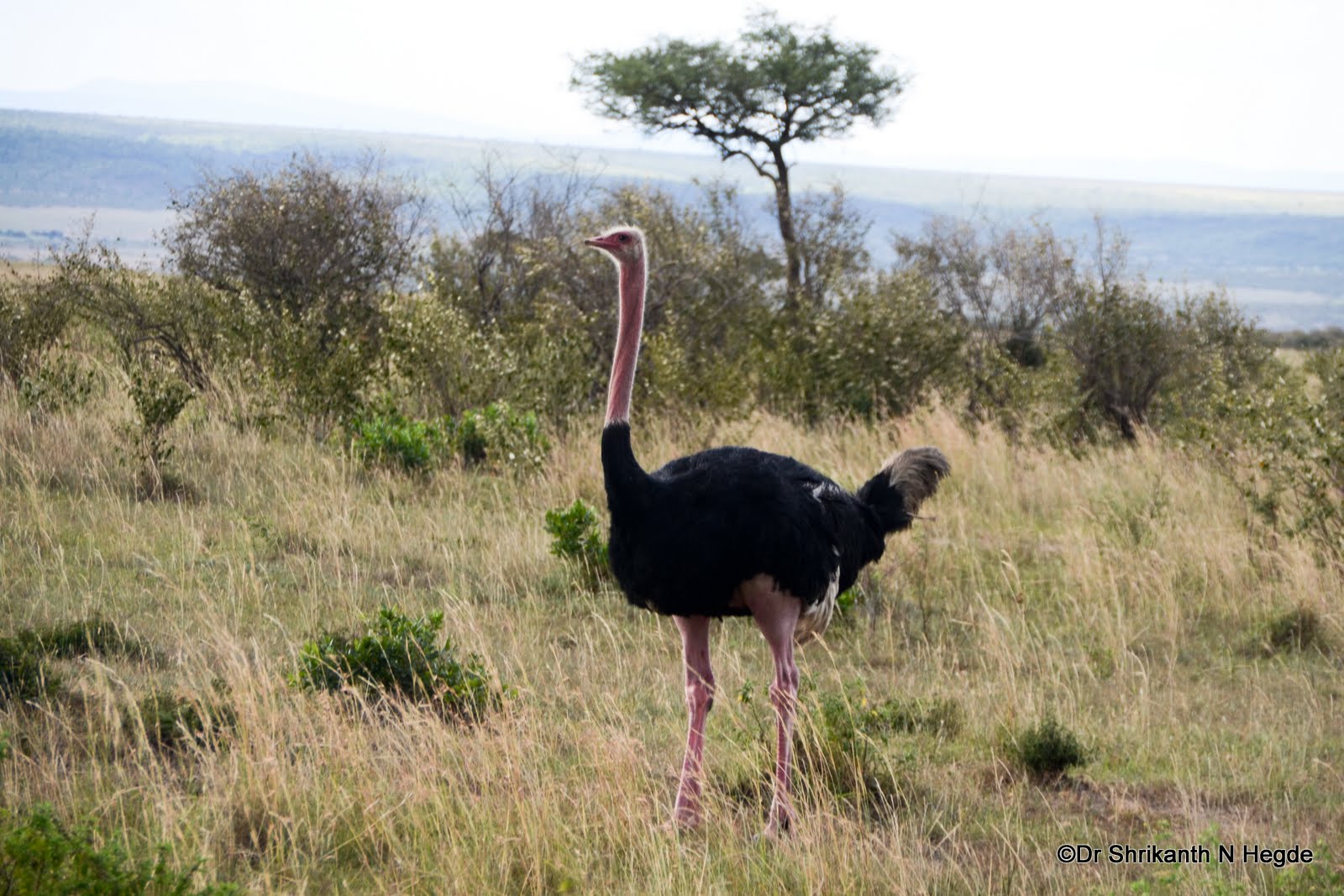
A male ostrich
For a full album of masai Mara please click here
Also you can click on the picture below to view the webalbum
Masai Mara derives its name from Masai tribe who are original tribal inhabitants of the region and the Mara river which flows through it dividing the reserve between Kenya and Tanzania. Though historically and geographically it is the same reserve now the southern part is in Tanzania (Serengeti National park ) and the kenyan part is Masai Mara. This is the savanna you will see in all National geography channel or animal planet ,Discovery etc.and is popular for the thick wild population it has . The great migration of animals from Tanzania to Kenya from july /August is migration into Masai Mara from serengeti .
Masai Mara is home to thousands and thousands of animals and during the period of great migration the numbers just change to millions . It is house for "Africa's Big Five"namely elephants, wild buffalos, Rhinos,Leopard and Lions along with count less wild beasts, Antelopes, Bucks, Gazelles, Impalas, Giraffes,Zebras, baboons, hyena,jackals etc. The birds in masai mara are more than 450 species with large variety of predators like eagles, harrier, Vutures etc. Ostrich, Lilac Breasted Rollers, etc are seen in plenty .
The biggest surprise in masai mara is the unique relation animals and man have ! Nowhere else in the world probably we get to see the wild life in such numbers and the close distance at which they can be observed and yet they remain harmless to human visitors is a wonder which cannot be put in words but has to be seen to believe! The very thought of a cheetah walking gracefully just a couple of feet from us and yet aloof of our presence , the mighty Lion sitting just a foot from safari jeep is something probably unique to african safari!
ALion family with their catch!
It's a day out for a herd of african elephants!
Whoever comes in safari van is not his concern when he is taking rest ! A cheetah resting unmindful of his visitors in safari jeeps!
Giraffes in Masai mara
Gazelles and Antelopes fill the landscape !
A male ostrich
For a full album of masai Mara please click here
Also you can click on the picture below to view the webalbum
![]() |
| Masai mara pics |
Subscribe to:
Posts (Atom)