Total Pageviews

Monday, January 16, 2012

Bar headed Geese at Magadi Tank

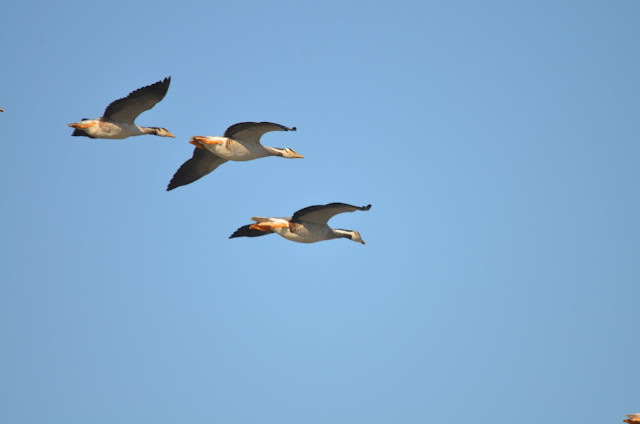
Magadi, a nondescript village in Shirahatti Taluk of Gadag District,Karnataka is special for an epic avian migration. Every year from December to March this village tank plays host to more than 2000 winged guests from Central Asia . Bar Headed Geese, from central asia like Kazagystan,Russia,Mangolia, Tibet , and also from ladakh region migrate to Indian sub continent to escape winter in their home country.While doing so they traverse one of the toughest bird migration path  crossing the peaks of Himalayas .Thogh there are passes in Himalayas these birds prefer to cross over the mountain range.These birds fly at an amazingly high altitude of nearly 30,000 fts at a speed of nearly 150 kms/hr covering a lap of 700-1000kms per day to scale the himalayan mountain range. remember even helicopters can't fly at this altitude and the temperature at this altitude is -50 degrees or so and air pressure sub atmospheric . The physiology of these birds in adapting to high altitude in extremely short time is amazing. This rapid ascent can kill human beings of high altitude pulmonary edema.After reaching India they pan out to various wetlands from assam to Bharathpur and down south upto Kanyakumari. One such destination in Karnataka is Magadi Tank.A village tank sprawling over 140 acres is the home for these guests for 3 months and at start of summer they fly back to their places. they breed in the mountain lakes of Tibet. I visited Magadi  along with my three other friends to watch these icons of migration which is a living example of tenacity and endurance! The challenging northward migration from lowland India to breed in the summer on the Tibetan Plateau is undertaken in stages, with the flight across the Himalaya (from sea-level) being undertaken non-stop in as little as seven hours. Surprisingly, despite predictable tail winds that blow up the Himalayas (in the same direction of travel as the geese), bar-headed geese spurn these winds, waiting for them to die down overnight, when they then undertake the greatest rates of climbing flight ever recorded for a bird, and sustain these climbs rates for hours on end

The bar-headed goose is known to be well equipped for this incredibly challenging migration. It has a slightly larger wing area for its weight than other geese, which is believed to help the goose fly at high altitudes.Studies have found that they breathe more deeply and efficiently under low oxygen conditions The haemoglobin of their blood has a higher oxygen affinity than that of other geese.

The Bar-headed Goose migrates over the Himalayas to spend the winter in parts of India (from Assam to as far south as Tamil Nadu.[8] The winter habitat of the Bar-headed Goose is cultivated fields, where it feeds on barley, rice and wheat, and may damage crops. Birds from Kyrgyzstan have been noted to stopover in western Tibet and southern Tajikistan for 20 to 30 days before migrating further south. Some birds may show high wintering site fidelity The bird is pale grey and is easily distinguished from any of the other grey geese of the genus Anser by the black bars on its head

Magadi village is  in Shirahatti taluk ,Gadag District ,Karnataka. It is located 26Kms from Gadag ,11 Kms from Lakshmeshwar,8 Kms from Shirahatti on Gadag-Bangalore Road (SH-6).
Latitude15.223911° N
Longitude75.514031° E

We left from Shimoga very early in morning by 4.30 AM and proceeded along Honnali,Harihar then onto NH 4 up to bankapur cross on NH 4. At Bankapur exited NH and drove along SH6 via savanur ,lakshmeshwar to reach Magadi by 8.15 AM. The srawling tank had very few birds that too at a considerable distance. An elderly man on the tank bund reassured us that birds start arriving by next 30 minutes.By 8.45 AM big flocks of birds in varying numbers started descending from horizon. Their formation in shape of > resembled landing of a jet plane in all their majesty.By next 30 minutes there were few thousand bar headed geese all over the Tank.Most of the m were in the middle of tank and started moving to sides slowly.Then we started moving around the tank.to get a better glimpse of bird and to get a nice picture.The only flipside to this is that the sides of the tank are  used extensively by villagers for open air defecation.Bar headed geese have a friendly relation with village people and swim close to shore even if there are are people washing clothes near the tank. But on sighting strangers like us they gradually move away.  The tank is well maintained and fenced on one side There is a bird watching tower and villagers whom you meet will be happy to guide visitors. An islet is created inside the tank with few trees and this acts a home to other water birds .Though Magadi tank is famous for bar headed goose there are plenty of other birds as well. We could sight be a eaters, Drongo,egret,white ibis, pond heron, bush chat, Hoope, sand piper, Painted storks ,grey heron,Golden oriole, asiaticKoel,Myna, purple more hen and black shouldered Kite around the tank area.
There are not many  facilities for visitors and also no entry fees! Fortunately there are no such activities like boating etc. which can disturb the birds. Food and water need to be carried .best time to visit is between December and January.This bird migration to Magadi is an annual event for 16 years !! When we left Magadi it was already 12 noon and in another 4 hours we were back home. It was somewhat tiring to drive eight hours but unusually I was not very tired may be because of the birds! If you consider the way they have travelled to reach Magadi my journey is not near any comparison.I feel God has created all equal. He has given so much to a small bird and given man many other things .He gave these birds ability to fly ,energy to sustain a long flight, adaptability and even ability to navigate great distance! He gave them inbuilt GPS ,navigation,and gave man intelligence to device all these! 

This article has taken useful resourses from:wikepedia.


Magadi has many more birds ,not just bar headed geese, here are some we could get :


Sandpiper


Blue cheaked Bea eater


Bea eater with its catch!


Common Hoope

Monday, December 12, 2011

Total Lunar Eclipse 10-12-2011

Tonight's Total Lunar eclipse: This was one of longest lunar eclipse which started early in evening at 6.38 PM and lasted till 9.48 Pm . I wanted to capture the whole event from start to end but due to a call in evening missed the initial parts. Though sky was clear for most part , during total eclipse phase clouds disturbed for some time. This was what I could get!

I have taken these photos with ISO 100-400 and slow shutter speeds. In these settings with slow shutter speed even shutter release button can cause camera shake and to avoid these I used wireless remote for shutter release. Another problem I encountered was after moon goes up higher in sky it is difficult to focus camera mounted on tripod . I resorted to hand held shooting with fast shutter speed and this turns images almost like black and white as seen in last two pictures. I learnt many useful things here and would like to improve upon in future photos .


Tuesday, December 6, 2011

Santebenuur Honda ( Puskarini)


Sante-Bennur, a small town situated in Channagiri Taluk in Davangere District, is a place of historical importance. It was called Sante-Bennur on account of the large weekly fair (sante) held there, and to distinguish it from Male Bennur, Rani Bennur and others of the name. It was founded, probably in the 16th Century, by a chief of the Basavapatna family, on the spot where a hare had been observed to turn upon the hounds, which indicated heroic soil.The settlement of traders and merchants was encouraged, and a large market sprung up.Hanumappa Nayak, one of the chiefs, erected a palace at Sante-Bennur and had skilfully constructed Pushkarni (reservoir) made in front of the ancient temple of Ranganatha, faced round with flights of steps and with ornamental pavilions at the angles and in the center.
The Pushkarni is the biggest in Karnataka and is renowned for its architectural beauty. With a length and breadth of 300 feet, it is 80 feet deep. In all eight directions there are small mantaps (Towers) of which only six are in their original shape. In the middle of this magnificent reservoir, there is a bigger tower called Vasantha Mantapa which is about 50 feet in height.It is said that Hanumappa Nayaka, built this Pushkarni and the temple of Lord Ranganatha along side it in the year 1658 AD. Ranadullah Khan, a sergeant of the Bijapur Sultan defeated Hanumappa Nayaka in a battle, destroyed the temple and constructed a mosque of large dimensions there. Hanumappa Nayaka who had been forced to retire to Tarikere and Kaldurga, was greatly incensed at this, and watching his opportunity planned a night attack, in which he put to death the Muhammadan governor, and desecrated the mosque and rebuilt the temple that existed there.
After his death, the town came under the rule of Tarikere and Chitradurga Palegars. The Bidnur Kings later rebuilt the fort around the town and restored the Pushkarni and the adjacent Temple to its original grandeur.It later fell into the hands of Haidar Ali.The mosque, never used since its desecration, and the Pushkarni, with its ruinous but graceful pavilions are the only points of interest now left.
( This information and text from wikipediahttp://en.wikipedia.org/wiki/Santhebennur )
Santebennur is in Davanagere district and about 45kms from Davanagere on Channagiri-Davanagere road.From Shimoga it is about 65 Kms. Shimoga to Channagiri 43 Kms and 20kms off NH towards Davanagere.


Wednesday, October 12, 2011

Kabini Photo Tour

Last week end I had ben to a photo tour at Kabini River Lodge ,Kabini about 80kms from mysore. Jungle lodges and resorts has its flagship resort which is the oldest property of JLR and famous for its wild life reserve .Kabini wild life reserve is now a part of Rajiv Gandhi National Park spreading over 650 sq.Kms covering parts of Mysore and Kodagu districts of karnataka. The famous nagara Hole national park is now a part of Rajiv Gandhi National Park. I joined the tour as a participant of Photo tour organized by Toe Hold Photography tours and Travel company. They conduct exclusive tours for those with photography interests and support with experienced and renowned photographers in the field. We were 15 in number from Karnataka, Andhra ,Kerala , delhi  and Haryana with 3 group leaders from ToeHold ,Giri Cavale,Philip Ross and Sachin Rai as mentors. The program me included 4 safaris ( 3 jeep and one boat). For most of us it was a unique experience with tips on wildlife photography by masters in the field and they did their best to teach us same. We had reasonably good sighting of wild life like Wid Dogs,Sambar Deer,Tuskers in parade , Leopard , Mangoose, Spotted Deer, birds like Changeable Hawk eagle,Crested serpent eagle, Osprey, Brown Fish Owl, Painted stork, darter, peacocks etc. The big cat Tiger eluded us but for me sighting the Leopard in wild for the first time was thrilling experience.

     Kabini ,once a hunting ground for the Royal family of Mysore and later for the British rulers was turned into a wildlife reserve in 1955 and as a national park in 1988.This forest is adjacent to Bandipur Tiger reserve forest and separated from it by the backwaters of Kabini river. Madhumalai forest, Wayanad forest are adjacent reserve forests and together they form part of Nilgiris bio diverse sphere of South India. The forest is rich in flora and fauna and variety of animals like Tiger,Leopard, Wild Dog, Elephants, Deers, Indian Gaur, Barking Deer, Mangoose, Crocodiles and birds are seen in this area. It is the largest habitat for Asian Elephants . About 65 tigers are estimated to be in this forest and though not counted an approximate 120 leopards are habitats in this forest. Once widely known for the mass elephant-trapping operations called 'Khedda', Kabini stands as the one of the brightest beacons for wildlife preservation in India today.More Than 100 varieties of bird are seen here
 Kabini is around 90 minutes drive from Mysore and the best place to stay is Jungle Lodges and Resorts.


A tusker on the bank of Kabini back waters


A Leopard in Kabini.


An Indian WildDog

Changeable Hawk Eagle


Spotted Deer

A sambhar Deer and a spotted Deer

For few more pictures of Kabini click on the picture below

Kabini

Tuesday, July 26, 2011

Gudavi Bird Sanctuary

White Ibis at Gudavi Bird Sanctary
Gudavi ,a small village about 14 kms from Soraba Town and 90kms from Shimoga City is a nondescript village like any other place but for the regular visitors to a small lake and adjoining trees surrounding the lake in the months of June till November every year. These winged visitors which number anywhere between 10-15000 start visiting the 70 hectares area in this village which is considered as an important bird sanctuary in Karnataka. Though the  number of bird species which visit here is small the big population of these birds make this sanctuary special.It might not be in comarision s with Ranganathittu but still considered as one of the best 5 bird sanctuaries of Karnataka. Gudavi is located 14 kms from Soraba Sorab can be reached from Shimoga by Shimoga--Shikaripur -Sorab route or via Shimoga--Sagar--Sorab route. If we take Sorab Banavasi Road and drive 10 kms and then 4kms  off the state highway we reach the forest department gate of Gudavi sanctuary.( Latitude 14º 26' N,Longitude 75º 46'E, Alt 551m). The place as such is beautiful with plenty of greenery surrounding, trees and a nice walking track for bird watching. There are about 5 bird watching towers and a platform into the lake. Entire area of the sanctuary is about 75 hectares .The birds start visiting by June end and start building their nests and August ,September is breeding season and by November end fly away with young ones. Though officially more than100 species of birds have been recorded here the large majority is by White Ibis which number upwards of 10,000. Egrets are next with thousands of them visiting every year. You can also spot with ease pond herons, grey herons ,snake birds, kingfishers, . Though this year many open billed storks have arrived I was not lucky to spot them . Asian spoon bills are also regular visitors here though this year they haven't arrived yet.
There are not many facilities except for a small canteen . But it is much better now with many benches, watch towers, toilet,walking track etc. and better road connectivity.Best time to visit is between September till early November. Sanctuary is open from 6AM to 6PM but ideal time is between 4PM to 6PM as birds return to their nests by this time.


Egret in flight


Grey heron


A part of walking track and bridge